
Caño Cristales, Colombia
A River That Changes Color, and the Golden Streams It Reminds Us Of

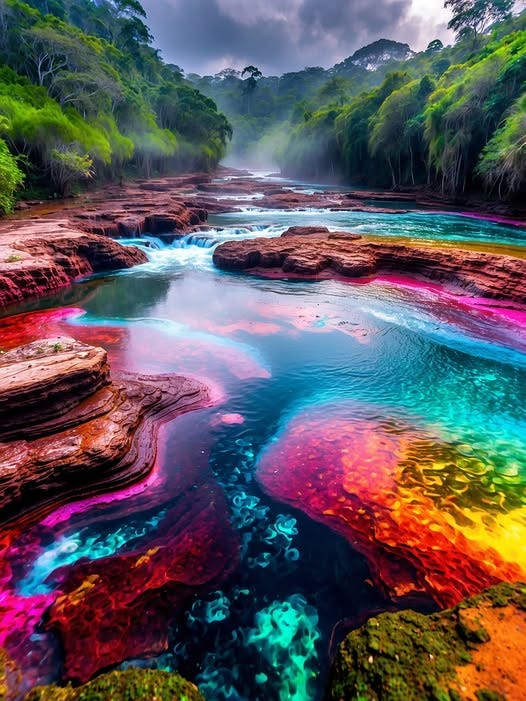
Deep in the Serranía de la Macarena, Colombia, flows a river that looks less like water and more like spilled rainbows. Caño Cristales isn’t tinted by dyes, camera tricks, or magic — it transforms each year thanks to an aquatic plant, Macarenia clavigera, which blooms in explosive reds, pinks, purples, and yellows when the water hits just the right level, temperature, and clarity. The river becomes a living prism, its colors shifting week by week, channel by channel, like a mood ring built by nature herself.
But here’s the twist: the water isn’t changing color — the riverbed is. The clarity of Caño Cristales is what allows the colors to shine through. It’s a reminder that some of the most spectacular things rivers do comes from what they carry, what they reveal, and what lies beneath the surface.
And that got me thinking about the poem’s most visual waypoint: the golden bending stream. While Caño Cristales paints rainbows in bloom, the Rockies paint gold in minerals, bending streams of mineral-gold tributaries the same way the stanza bends its clues.
Near here it's nestled all in dream.
I've other treasures left to hide.
I'll miss the golden bending stream,
but I must go back to my ride.
High-altitude tributaries in the Rockies can also shift dramatically in color, but for very different reasons. In regions with historic or active mining, mineralized tributaries can turn a striking golden-amber hue. Iron oxides, sulfides, and trace heavy metals leach from exposed rock, tailings, and ore-rich drainages. When those minerals meet oxygen, sunlight, and turbulent canyon geometry, the water takes on the color of liquid gold, especially in the slower bends where particulates settle and light refracts through the mineral load.
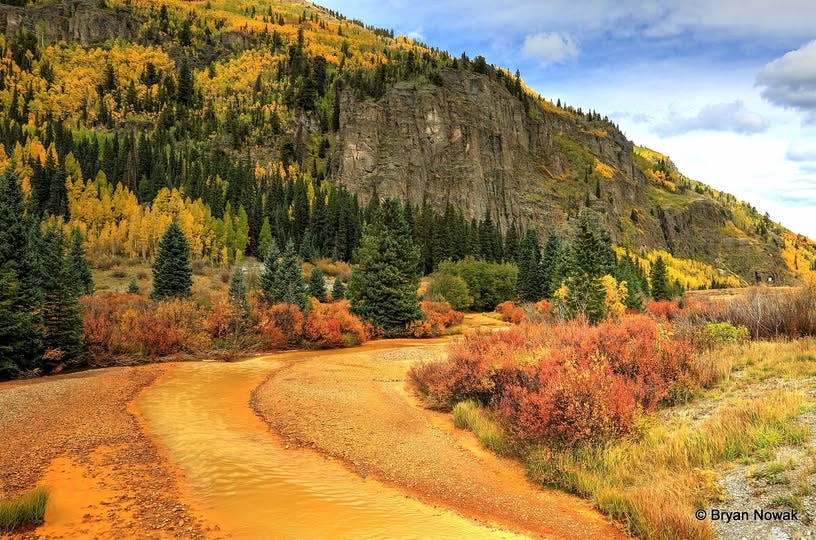
Unlike Caño Cristales, this is color born not from biology, but geochemistry: the fingerprints of the mountains themselves dissolving into the streams.
Is it always healthy for the watershed? No. Is it visually spectacular in the right conditions? Absolutely. And in the context of terrain language, it becomes incredibly useful.
Because mineralized streams don’t run straight. They:
Bend where valleys bend
Pool where metals drop out
Change color where tributaries shift chemistry
Glow gold where minerals dominate the flow path
Which means a phrase like “golden bending stream” can be more than poetic flourish — it can be shape + color + sequence.
Near here it’s nestled all in dream.
I’ve other treasures left to hide.
I’ll miss the golden bending stream,
but I must go back to my ride.
If we interpret this the way a river navigator or terrain reader might:
“Near here” → proximity — close to the prior clue region
“nestled” → recessed, tucked into concave terrain, like a tributary alcove or side drainage
“all in dream” → playful tone, possible hint at mining-dreams that glittered harder than they yielded
“left to hide” → while going back, he is telling us to also go left to the hide
“I’ll miss” → is he’s being sentimental or is he including this hint to leave the golden stream behind and go back (circle back)?
“golden bending stream” → a visibly mineralized tributary that curves — gold-colored water that bends
“back to my ride” → departure from the golden bending stream— going back to the trail, vehicle, road, or access route
The stanza reads like someone saying:
I’m close. It’s tucked in. The gold stream bends here. But I have to head back
Which fits with the path not being exactly linear, but more circular or circling-back…
“It may be more circular… read the poem and try to decipher it out…”
—Original Branch
I’f I had to guess, I think the AT box will be found first.
I haven’t been BOTG yet. Hopefully late in March, if the snow melts down by then. My solve(guess) is at 10,000 ft. “… worth the high.” I live at sea level so I better get in shape. Lol. Have you been BOTG?
Great insights but you’re on to my solve.. 🤫