
Mapping the Journey
A Homage to Forrest Fenn ΩΩ

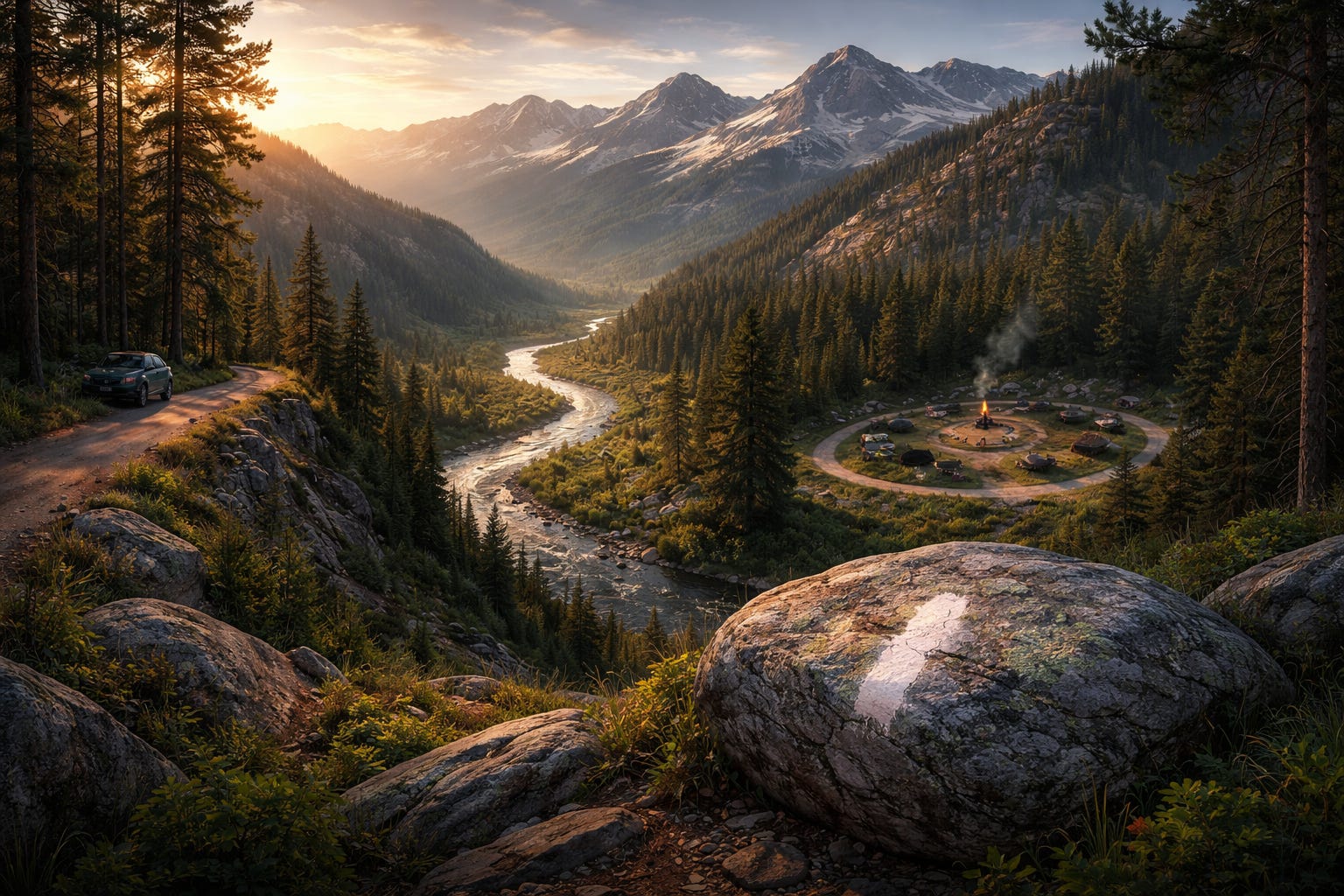
Both the original Forrest Fenn poem and the JCB tribute poem unfold like maps written in verse, trails of thought and geography intertwined. Each stanza is a layer — access, trajectory, elevation, micro-terrain, and final confirmation — carefully constructed, inviting the reader to “marry the clues to places on a map,” echoing the original spirit of Forrest Fenn.
Stanza One: Access and Orientation
I cruise along a road I know
and park my car just off the side,
near where I'd searched for heavy loads.
It was not there, although I'd tried.
The poem begins with a flashback. The beginning is the end and perhaps the most important stanza to pay attention to. The important question to ask: How can the reader identify the correct road if all we have is the poem?
Jon Collins-Black has openly discussed his hobby of off-road 4WD driving, even mentioning in conversation that he drives a Land Rover.
But that fact is beyond the point here. The opening stanza is where the poem must prove that the “road he knows” is decipherable from the text alone, without leaning on proximity, timing, or insider access. The original Forrest Fenn chest was revealed to have been located not by solving the poem, but by catching an external slip-up in an interview, undermining the idea that searchers simply suffered from “confirmation bias.” A puzzle that withholds its decisive information cannot blame the solver for failing to read it correctly. JCB is intentionally avoiding that flaw, keeping the hunt constrained to what is written on the page and embedding its orientation internally through structure rather than story.
Embedded within the lines of stanza one are the five capital “I”s, configured in a 2–3 pattern forming an X. Though cryptic, this structure identifies a specific corridor— a county road that frames the entire expedition.
Stanza Two: Trajectory
With the corridor established, the poem shifts from access to direction.
Begin it where cool water flows
and follow through the canyon round.
Take in the rolling highs and lows
pass by a place where once was Brown.
“Begin it where cool water flows” describes geography on a macro level. Pacific drainage west of the Continental Divide becomes the constraint. The map narrows.
“Canyon round” introduces trajectory — a bend, a turn, a change in bearing.
Then comes the hinge.
At first glance, Line Seven reads as atmosphere:
“Take in the rolling highs and lows.”
It feels scenic. Emotional. Observational.
But the sentence does not end there.
When read as structured — not skimmed — the grammar locks into place:
Take in the rolling highs and lows Pass.
The operative noun is not “highs.”
It is pass.
The phrase ceases to be mood and becomes navigation.
The hinge lands.
Elevation undulates — not metaphorically, but physically — resolving to Tennessee Pass, whose rolling grade mirrors the phrasing with striking precision.
Only after identifying the Pass does the next clause activate:
“…by a place where once was Brown.”
Stanza Three: Elevation and Bearing
With the Pass identified, the poem narrows again.
From here you are more on your own.
The path is always drawing nigh.
The compass points now towards the home
of point and tree and seeing eye.
The first line signals transition.
“From here you are more on your own.”
This is not philosophical drift. It is geographic shift. A crossing. A departure from maintained corridor into higher, more self-reliant terrain.
The hunt climbs.
Then the compass activates.
“The compass points now towards the home of point and tree and seeing eye.”
On first reading, the line feels abstract — almost ornamental. But like stanza two, it is built as a mechanism.
Point
Tree
Seeing eye
Pointing
Treeing
Guiding
The poem overlays word association onto bearing direction. Linguistic play becomes geographic vector. The compass is no longer decorative; it is directional. It projects toward a narrowing micro-zone without naming it outright.
Stanza Four: Micro-Terrain
By the time the poem reaches stanza four, scale has already narrowed from road to Pass to bearing. What remains is compression — a final reduction from landscape to object.
Stop just beyond the campers blaze.
A thinker’s stone is all you need;
the spot is set with marvel gaze,
a white mark shows upon the seat.
The key phrase is “campers blaze.”
There’s no apostrophe.
It’s not “camper’s blaze.” It’s plural.
The structural question becomes: where in the text does JCB establish blaze as a plurality formation rather than a singular flame?
Chapter Nine provides the answer.
On pages 93–94, JCB recounts a Christmas Eve candlelight vigil:
“Deacons came around the circle and handed out an unlit candle to each person… the interior lighting was turned off. The only light source that remained was the glow and soft flicker of candlelight… the flames steadily stretched around the room as a soft circular glow of candlelight lit up the sanctuary.”
The description is precise:
a circle.
candles passed person to person.
flame stretching around the room.
a soft circular glow.
Later, he writes:
“She ran across the room, through the circle of the candlelight vigil…”
The formation is explicitly circular.
The blaze is not a single flame.
It is a ring of flames.
When stanza four instructs, “Stop just beyond the campers blaze,” the structural echo becomes clear.
Translated into terrain, that formation mirrors a campground loop — campsites arranged in a ring, each designated site capable of producing its own blaze. The poem does not need to say “campground.” It has already encoded circular blaze imagery in Chapter Nine.
From there, scale compresses further:
“A thinker’s stone is all you need.”
The corridor collapses into a single rock — macro becomes micro.
“The spot is set with marvel gaze.”
Orientation returns in reduced form — no longer compass-wide, but etched into stone. A route line. A sightline.
Stanza Five: Reflection, Release and Loop Closure
By stanza five, the map has narrowed to its smallest unit — stone and mark. What follows is decompression.
Near here it’s nestled all in dream.
I’ve other treasures left to hide.
I’ll miss the golden bending stream,
but I must go back to my ride.
“Near here it’s nestled all in dream.”
The phrasing softens. But softness does not mean vagueness. Throughout There’s Treasure Inside, JCB repeatedly frames meaningful locations as places of stillness — spaces where memory and terrain overlap. The word “dream” signals atmosphere. It suggests harmony with environment.
This is consistent with his narrative style: locations matter because of what they evoke.
“I’ve other treasures left to hide.”
This line echoes the broader philosophy of Forrest Fenn, who insisted the mountains themselves were the greater treasure. The landscape holds abundance. The line reinforces that the poem encodes one location among many meaningful places.
But structurally, the most important line is the last:
“I must go back to my ride.”
The poem closes the loop.
Stanza one established a vehicle-access corridor — a forest road, a turnout, a reachable point. Stanza five confirms that the search never abandoned that boundary. The treasure is not days deep in wilderness. It is within a defined, repeatable approach.
The corridor holds.
Then comes the line that appears sentimental but operates geographically:
“I’ll miss the golden bending stream.”
A backward glance. The drainage described earlier now becomes memory. The stream bends; the narrative bends with it. The author departs, but the geography remains.
Stanza Six: Constraint, Boundary, and Integrity
The poem does not end with flourish. It ends with conditions.
So listen well and hear me all,
your efforts will be worth the high.
If you can mark warm water’s halt,
you’ll bring it back full weight and dry.
“So listen well.”
The closing stanza demands precision.
“Your efforts will be worth the high.”
Elevation returns one final time. The hunt has consistently reinforced alpine terrain. High ground. Rolling passes. Drainage basins. The geography has never descended into abstraction.
Then comes the decisive line:
“If you can mark warm water’s halt…”
Read casually, it sounds poetic. But read through the lens of Chapter 13 — “Reality hit me like an avalanche” — the vocabulary sharpens.
The halt is not arbitrary.
It is where terrain forces momentum to surrender.
Earlier in the poem, water language was filtered through geography (“cool water flows”). Here, water language defines boundary.
“Warm water’s halt” reads as a boundary condition — the depositional limit where energy exhausts itself.
“You’ll bring it back full weight and dry.”
Like a mining grizzly that stops larger rock as motion slows, the halt leaves what is solid behind — intact and recoverable.
Conclusion
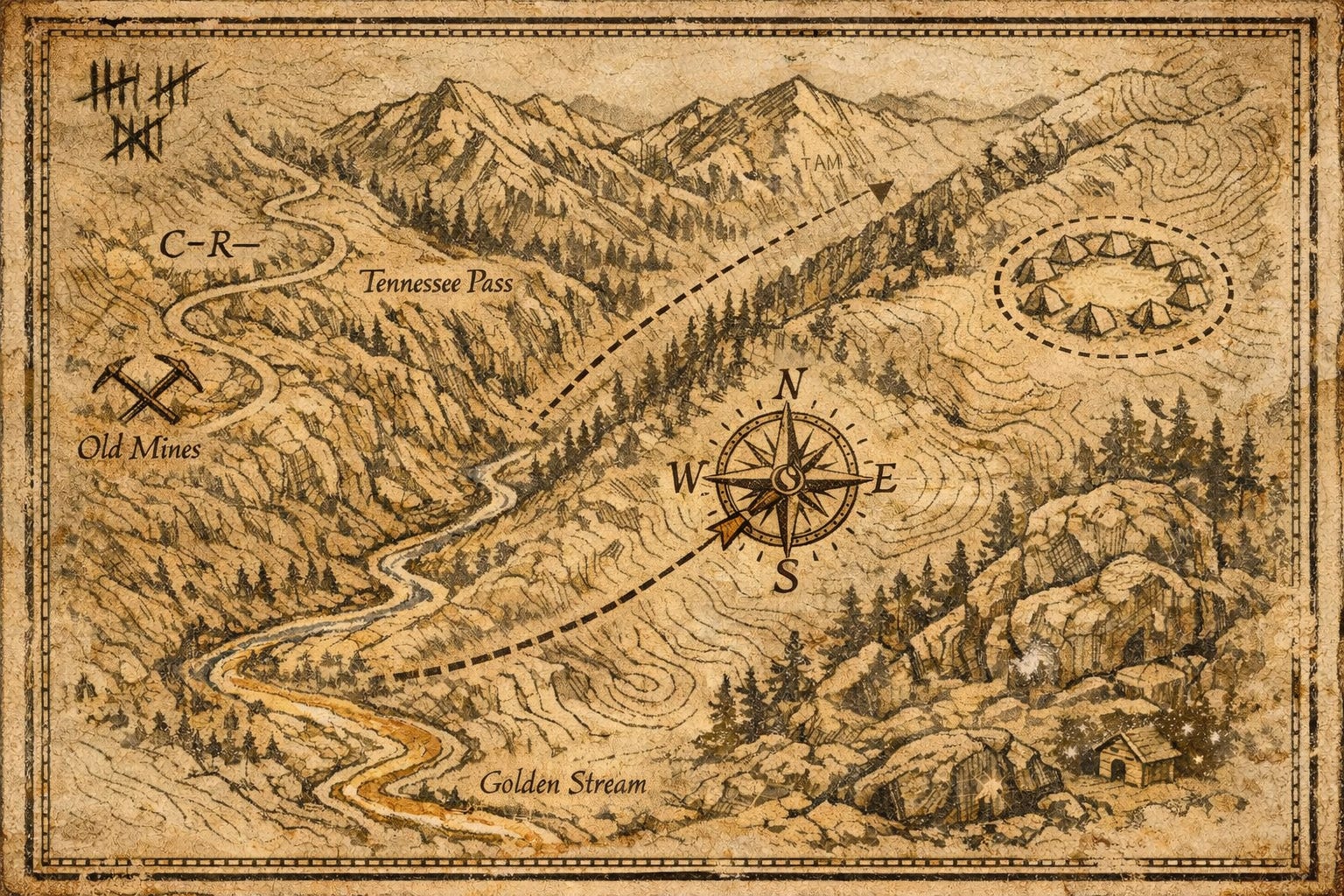
JCB’s poem is a masterclass in marrying verse to topography. Every line functions as a coordinate in both space and thought, weaving road, pass, canyon, and boulder into a layered narrative. It honors Forrest Fenn’s philosophy: the journey matters, the terrain teaches, and the map is the lens through which the treasure exists.
The reader is invited to trace the thought, observe the land, and feel the elevation, following a poet-cartographer who balances adventure, intellect, and reverence for the wild.
—Original Branch
Interesting! I’m still on the fence if it’s “lows pass” or “pass by a place…”
You had posted a video of driving on a winding road and JCB is narrating his FF poem. He pauses after “lows” as if the “pass by..” is the next thought or sentence. I know there is no comma or period.
What do you think about this? 💎